

Everyone knows that learning SEO takes time. However, what wastes even more time is working in the wrong direction. Many bloggers spend months writing content and trying to build backlinks, yet their traffic remains at zero. Often the issue is not a major strategic failure but rather small mistakes that undo all their hard work.
This article covers 10 mistakes that almost every beginner makes and explains, in practical terms, how to fix them.
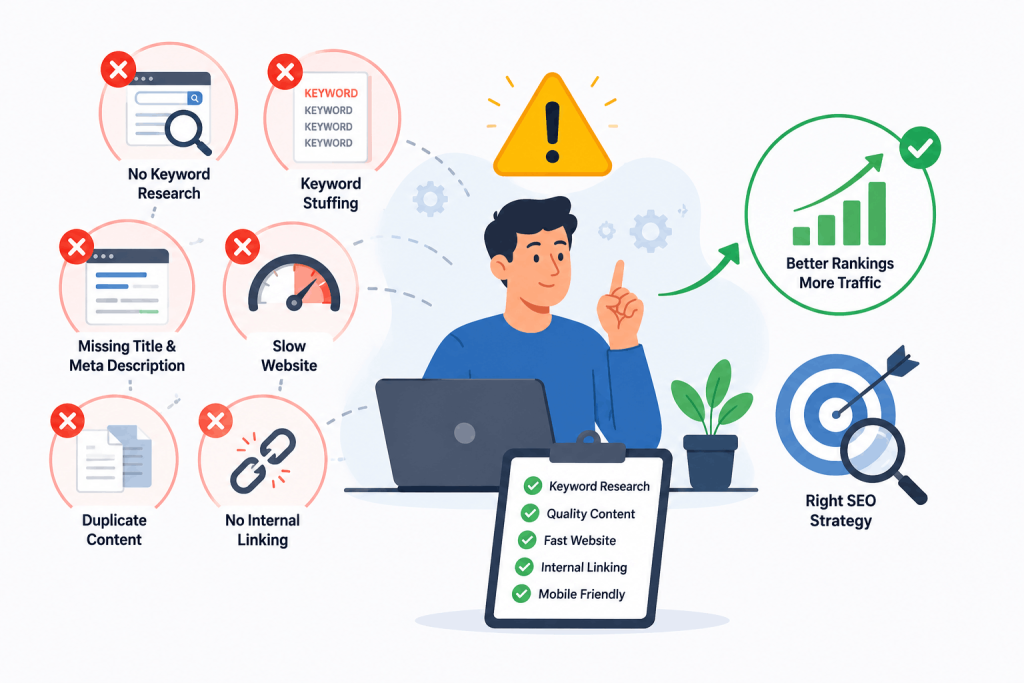
Mistake 1 — Writing Content Without Keyword Research
This is the most common and damaging mistake.
Many beginners choose topics based solely on personal preference writing about whatever they find interesting. The problem is a huge difference between an interesting topic and a searchable one. You might put in hours of hard work to publish an article but if no one is searching for that topic, where will the traffic come from?
Fix: Before writing any article, use tools Google Keyword Planner or Ubersuggest to verify that the topic has search volume. Even just 100 to 200 monthly searches are sufficient for a new blog but do not waste time on topics with zero searches.
Mistake 2 — Keyword Stuffing
There was a time when stuffing more keywords meant better rankings—but that is no longer true in 2024. Google’s algorithm has become highly sophisticated and easily identifies keyword stuffing.
If the phrase “best SEO tips” appears 25 times in an 800-word article, it feels unnatural; it irritates the reader, and Google may even penalize the content.
Fix: Maintain a focus keyword density of 1%–1.5%. Using the keyword 10–12 times in a 1,000-word article is sufficient. Elsewhere, use synonyms and related terms—such as “search engine optimization,” “website ranking,” or “organic traffic”—as these integrate naturally into the content.
Mistake 3 — Ignoring the Title Tag and Meta Description
Many beginners publish articles on WordPress but leave the SEO title and meta description blank—or simply let the H1 heading automatically become the title.
This is an area that directly affects your click-through rate. The blue link visible in search results, along with the two lines of text beneath it, forms the reader’s first impression. If this isn’t compelling, people won’t click—even if you rank well.
Fix: Manually fill in the SEO title and meta description for every article using Rank Math. Keep the title between 50–60 characters and the meta description between 150–155 characters. Ensure your focus keyword appears naturally in both. Try to write something compelling—don’t just stuff the keyword in.
Mistake 4 — Ignoring a Slow Website
“My content is great; what difference does speed make?” — this mindset has ruined the rankings of many websites.
Google has officially confirmed that page speed is a ranking factor. In practical terms, too, if a site takes 5 seconds to load, the reader hits the “back” button. A high bounce rate signals to Google that the page lacks value, causing rankings to drop.
Fix: Enter your URL into Google PageSpeed Insights (pagespeed.web.dev). Address the issues that appear—compress images to WebP format, install a caching plugin (like W3 Total Cache or WP Rocket), and delete unnecessary plugins.
Mistake 5 — Creating Duplicate Content
Copying the same content and publishing it across multiple pages—whether within your own site or copied from another site—creates a duplicate content issue for Google.
Google gets confused about which page to rank. The result? The ranking of both pages suffers.
Fix: Write unique content for every page. If you need to publish an article on another site as well, use a canonical tag pointing to the original source page. Also, check your own site to ensure there aren’t two pages with similar content—you can perform a free audit using Screaming Frog.
Mistake 6 — Not Doing Any Internal Linking
When writing content, people often focus solely on the article at hand and forget to link to other articles. This is a simple task that makes a significant difference.
Internal links serve two purposes: they help Google better understand and crawl the entire site, and they encourage readers to navigate from one article to another, thereby increasing the time spent on the site.
Fix: Every article should contain at least three internal links. Whenever you mention a related topic, link to your previous article. Keep the anchor text descriptive; instead of “click here,” it is better to use phrases like “Keyword Research Step-by-Step Guide.”
Mistake 7 — Targeting Only High-Competition Keywords
Starting a new blog and immediately targeting keywords like “digital marketing” or “make money online” is the most frustrating mistake because it never yields results.
There are already hundreds of thousands of articles and long-established sites covering these keywords; competing with them is almost impossible for a new blog.
The Fix: Start by targeting only long-tail keywords—phrases with three or more words and low keyword difficulty. Examples include “how to learn digital marketing at home” or “free keyword research tools for Hindi bloggers.” The traffic volume might be lower, but your chances of ranking will be ten times higher.
Mistake 8 — Ignoring Mobile Optimization
Over 80% of internet users in India are on mobile devices. If your site doesn’t display correctly on mobile—for instance, if the text is too small, buttons overlap, or images extend beyond the screen—then the majority of visitors will have a poor experience.
Google uses mobile-first indexing, meaning it evaluates the mobile version first and the desktop version later.
Fix: Use Google’s free “Mobile-Friendly Test” tool at search.google.com/test/mobile-friendly. If issues arise, switch to a responsive theme. Astra and GeneratePress are both free and perfectly mobile-friendly.
FAQ:
Can a single mistake trigger a Google penalty? A single mistake doesn’t immediately result in a penalty; however, repeated keyword stuffing or purchasing paid links can certainly lead to a manual penalty. Most mistakes merely slow down rankings rather than destroying them—just make sure to fix them in time.
I’ve made a lot of mistakes—is recovery still possible? Absolutely. On-page issues—such as title tags, meta tags, and keyword density—can all be fixed in a single day. For spammy backlinks, there is the Google Disavow Tool. The time it takes to recover depends on the nature and duration of the errors, but recovery is definitely possible.
Conclusion — Learn from Mistakes, But Fix Them Quickly
Every blogger makes these mistakes—there are no exceptions. The only difference is that those who identify and fix them quickly get ahead.
Use the list provided in this article as a checklist. Audit your site, fix any errors you find, and move forward. SEO is an ongoing process—perfection doesn’t happen on day one.
Next Page- https://neuroagent.in/seo-vs-google-ads/
