

Until three years ago, people considered SEO a secondary skill. Today, every digital agency, e-commerce company, startup, and media house has dedicated SEO roles—and the demand far exceeds the supply.
If you want to build a career in SEO within digital marketing—or are already working in the field and want to grow—this guide has been written specifically for the Indian context. Here, you will find information on salary ranges, job roles, and essential skills, along with a clear, step-by-step roadmap.
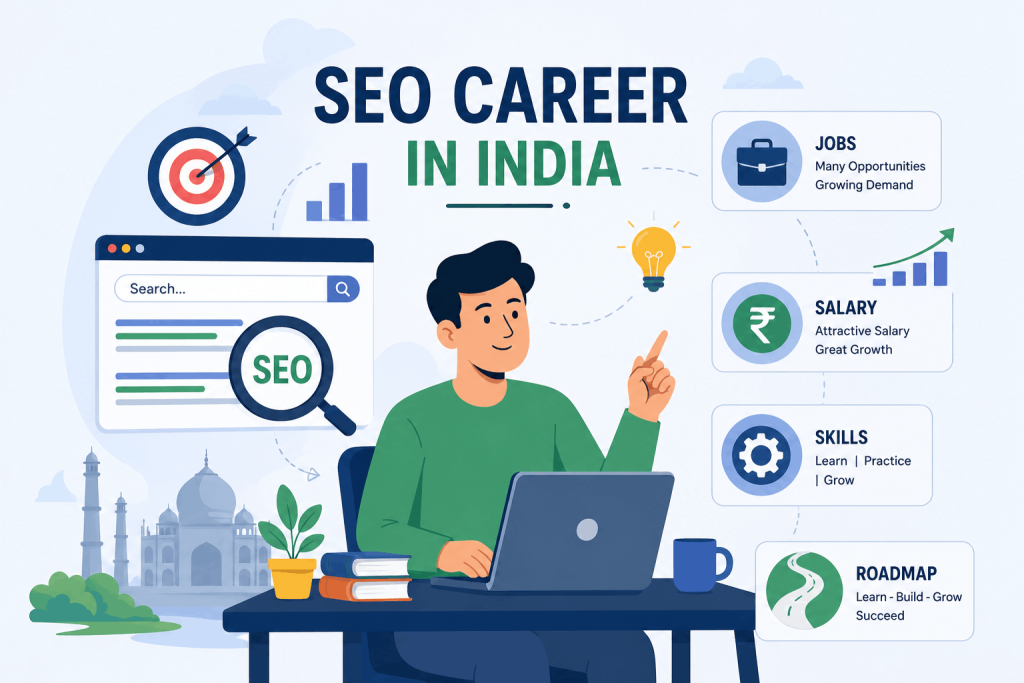
What is the scope of SEO in India?
To put it simply—it is immense.
The number of internet users in India has crossed the 900 million mark in 2026. Every business looking to establish an online presence needs SEO—whether it is a local restaurant in Jaipur or a funded startup in Mumbai. Yet, the number of professionals who can actually execute this work remains very low compared to the demand.
Search for “SEO executive” or “SEO specialist” on platforms like Naukri.com or LinkedIn, and you will find thousands of job openings. Opportunities exist at every level—from entry-level to senior roles, and from freelance work to full-time positions.
This is a field where a college degree isn’t mandatory; skills are what matter. A strong portfolio is far more valuable than an average degree.
What Are the Different Jobs in SEO?
Many beginners think SEO is just a single job. In reality, it involves a full career ladder.
SEO Executive / SEO Analyst — This is an entry-level role. Tasks include keyword research, on-page optimization, rank tracking, and basic reporting. Freshers typically start here.
SEO Specialist — A role for those with 1–2 years of experience. It involves more independent work, such as technical SEO, content strategy, and backlink analysis. Client communication also begins at this stage.
SEO Manager — Requires 3–4 years of experience. This is a leadership role involving the design of the overall SEO strategy, team management, and reporting results to clients.
SEO Lead / Head of SEO — A senior-level position. Responsibilities include strategizing for multiple projects or clients, building teams, and aligning SEO efforts with business goals.
SEO Freelancer / Consultant — This role can be pursued at any career stage. Freelancers manage their own clients and set their own schedules. Freelance SEO is growing rapidly in India, especially in Tier-2 cities.
How much is a SEO’s salary in India?
This is the most frequently asked question—so let’s be honest about it.
| Role | Experience | Monthly Salary Range |
| SEO Executive | 0–1 year | ₹12,000 – ₹22,000 |
| SEO Analyst | 1–2 years | ₹20,000 – ₹35,000 |
| SEO Specialist | 2–4 years | ₹35,000 – ₹60,000 |
| SEO Manager | 4–6 years | ₹60,000 – ₹1,20,000 |
| SEO Consultant (Freelance) | 2+ years | ₹50,000 – ₹3,00,000+ |
These ranges are approximate and depend on factors like city, company size, and skills. Salaries are generally higher in cities like Delhi, Mumbai, and Bangalore. However, remote work has become very common, so location is no longer the barrier it used to be.
Freelance SEO consultants who handle international clients can easily earn between ₹1 lakh and ₹3 lakh per month. This is a realistic figure, not an exaggeration.
What Skills Do You Need for an SEO Career?
Here is an honest breakdown—focusing on what actually works, not just what looks good on a resume.
Keyword Research — This is the foundation. If you don’t know what people are searching for and why, all other skills are incomplete. Learn the basics of tools like Google Keyword Planner, Ubersuggest, or Ahrefs.
On-Page Optimization — Title tags, meta descriptions, heading structure, internal linking—an SEO professional should know these instinctively. Being able to look at a client’s page and identify exactly what needs fixing is a skill you can master within six months.
Technical SEO — Site speed, crawlability, XML sitemaps, robots.txt, Core Web Vitals—this is advanced territory, but you won’t land senior roles without it. A basic understanding suffices at the start; deep expertise comes later.
Content Strategy — Finding keywords isn’t enough; deciding which topics to cover, when to write, the format to use, and the target audience is also part of SEO.
Analytics — Google Search Console and GA4—interpreting data is essential. If you can’t report to a client on what improved and why, you become replaceable.
Link Building — Guest posting, outreach, broken link building—this is a practical skill that can’t be learned through theory alone. You only truly learn it by running a real campaign.
Step-by-Step SEO Career Roadmap
If you are starting from scratch, follow this sequence.
Months 1–2 — Solidify the Basics
Dedicate the first few months to SEO fundamentals. Gain a deep understanding of what SEO is, how Google works, on-page basics, and keyword research. Don’t just read about it—create a free blog on WordPress or Blogger and implement what you learn practically. Theory and practice go hand in hand.
Take Google’s free “Fundamentals of Digital Marketing” course—you get a certificate for it, too. HubSpot’s SEO certification is also free and looks great on your resume.
Months 3–4 — Learn the Tools
Set up Google Search Console on your blog. Link Google Analytics. Conduct competitor analysis using the free version of Ubersuggest. Perform a site audit using the free version of Screaming Frog.
Simply watching YouTube videos about these tools won’t suffice—you need to use them yourself, make mistakes, and fix them. Hands-on experience is where real learning happens.
Months 4–6 — Build a Portfolio
This is the most important step that people often skip.
Work on a real website—whether it’s your own, a friend’s, or a local business’s—and document what you did and the results you achieved. “I increased traffic to Website X from 0 to 500 per month in three months”—that is the kind of resume line that actually works.
Without a portfolio, none of your claims can be verified during an interview. With a portfolio, you let the results speak for themselves.
Months 6–9 — Apply for Jobs or Start Freelancing
You are ready now. Apply for jobs on LinkedIn and Naukri.com—look for “SEO Executive (Fresher)” or “SEO Trainee” positions. Make sure to include a link to your blog or project in your cover letter.
For freelancing, create profiles on Fiverr, Upwork, and LinkedIn. Start by working at lower rates to build up reviews, then raise your rates. This strategy works consistently.
Months 9–12 — Specialize
After a year, decide which direction to take—whether to become a technical SEO specialist, a content strategy expert, or specialize in local SEO. Depth is always valued more than being a generalist.
Certifications That Actually Add Value
There are several free certifications that add weight to your resume:
- Google Digital Garage — Fundamentals of Digital Marketing — free, Google-certified.
- HubSpot SEO Certification — free, practical, and widely recognized.
- Semrush SEO Toolkit Course — free, tool-specific but very detailed.
- Google Analytics Certification — free, based on GA4 — demonstrates data skills.
- Paid certifications aren’t necessary at the start; these four free ones are enough to help you land your first job.
Freelance SEO vs. Full-Time Job — Which is Better?
The straightforward answer: get a job first, then move into freelancing.
A full-time job gives you the opportunity to work on real campaigns, learn from seniors, and gain experience in client communication—all while the company bears the risk. This foundation proves invaluable when freelancing.
Those who jump straight into freelancing without real-world experience often get stuck, as the consequences of any mistakes directly impact their client relationships.
Work a job for 1–2 years to build both your skills and confidence, then start taking on your own clients.
FAQ:
Do I need to know coding to learn SEO? Understanding basic HTML—such as title tags, meta tags, and heading structure—is helpful, but coding skills are not mandatory. SEO professionals working on platforms like WordPress can reach senior-level roles without knowing how to code.
Can people from Arts or Commerce backgrounds enter the field of SEO? Absolutely. An engineering degree is not a requirement for SEO. Writing skills, analytical thinking, and curiosity matter far more than a technical degree.
Is an SEO career stable, or will it eventually disappear? As long as Google exists, SEO will remain relevant. Algorithms change and tactics evolve, but no business can afford to ignore organic search visibility. SEO evolves; it does not disappear.
Conclusion — An SEO Career is a Solid Long-Term Choice
The barrier to entry for an SEO career is low, growth is rapid, and demand remains consistently strong. You don’t need a premium course or an expensive certification right from day one—you can get started with a free blog, free tools, and genuine curiosity.
Remember the roadmap: learn the basics, practice with tools, build a portfolio, apply for jobs or start freelancing, and then specialize. Work consistently at every step, and the results will follow.
